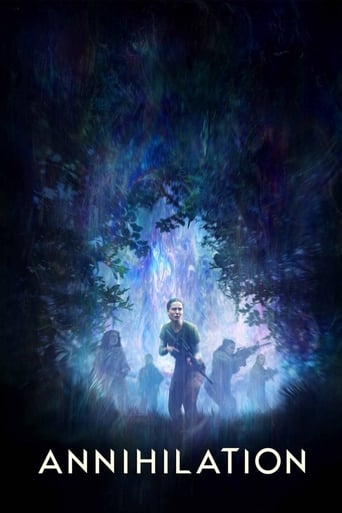
Alex Garland is the sh*t in my books, and can do no wrong. And yet, I am not 100% sure about this film.
There are many things I *really* like. For example:
- In retrospect, the **'Stalker'** vibe, the **'Contact'** vibe, the **'Arrival'** vibe, the **'The Fly'** vibe, and the **'Alien'** vibe are noticeable, but suitably subtle.
- The fact that the vast majority of the cast are female -- and the film doesn't make a big deal out of it -- is awesome. There are no crass jokes about their periods syncing up, and there's no airy-fairy "feminine intuition saves the day" stuff. As far as the film's marketing goes, I think **Annihilation'** could be 2018's anti-**'Ghostbusters'**.
- The dream-like atmosphere the film conjures through the use of alien environments, flashbacks and a weird, dispassionate, investigative framing device is refreshing. At times, it feels like a time travel film.
- **'Annihilation'** is purposeful and thoughtful, and takes its time doling out information. It lets you feel smart. Moreover, there's information that it just decides to never dole out at all.
- All the performances are great, except for Jennifer Jason Leigh, who spoke every line in a droll, musing way, as if she were carrying on a late-night conversation at a sleepover while struggling to not fall asleep. Oscar Isaac was maybe more somber than his typical Poe Dameron self, but at times his chemistry with Natalie Portman was surprisingly good.
- It starts slow, but overall the pace is decent, and I appreciated how the filmmakers were wise enough to add some action elements to what could have easily become an overly-intellectual plot.
- **'Annihilation'** is not all super-shiny and slick and mindless like much of modern science fiction, and it actually leaves you with a lot to think about when it comes to loss and regret and humanity's penchant for self-destruction.
But as much as I liked the above, there are several issues that threatened to torpedo my enjoyment of this film (spoilers ahead):
- The rare parts where this film began mimicking typical science fiction tropes only served to make it predictable. As soon as Sheppard had that lengthy little soliloquy in the boat, talking about the loss of her daughter, and how she suffered two losses that day: the death of her daughter and the death of who she used to be... well, you knew it wasn't going to be long before she fell off a cliff or got strangled by a mutant alien plant.
- It is extremely unlikely that any scientist would refer to the Shimmer as a potential "religious event".
- The chain-of-command of the mission was sketchy. If this was a military excursion, the authority of Ventress should have been the final word, but almost immediately, Lena is making decisions and everyone is happily going along with them.
- Similarly, most of the squad immediately turns against Lena for withholding information, which really didn't seem justified, despite the growing sense of paranoia.
- Jump scares. Someday filmmakers will realize how cheap these are, even when they involve giant alligators.
- The score cycles between indie guitar-plucky noodling, and loud **'Inception'**-BWWAAAMs, and neither did the film any favours.
- Bad science for what seems to be a hard-science film.
- The whole "refracted DNA" explanation of the Shimmer phenomena was surprisingly unscientific. First, the term doesn't really *mean* anything, and second, human DNA is so resistant to being manipulated that cells typically choose to self-destruct when this happens. (See, for an example, the grim effects of ionizing radiation.)
- A tattoo does not change your DNA, so refracted DNA cannot explain how that Ouroboros tattoo leaps from Anya's arm to Lena's.
- Red blood cells have no DNA, and don't divide, so Lena's blood tests in the field make no sense.
- There's also no rational way that this alien CRISPR effect could possibly account for a bear-creature mimicking human language because it recently consumed a human. I mean, come on, I'm game for *some* suspension of disbelief, but that's just nuts (and kind of ripped off from **'The Ruins'**, to boot).
- The psychedelic, wordless, **'2001'**-esque climax didn't really add much to the rest of the narrative. It was a little too long and too **Cirque du Soleil** for my tastes, and was so vague and open-ended that it felt like it was merely pretending to be deep, rather than actually representing something profound.
- I guess I am ultimately concerned that this film doesn't have as much to say at it might seem. Lena's description of the alien's possible intent ("I'm not sure it wanted anything") is not a particularly compelling or meaningful wrap-up of the story. Is it not more accurate for her to say that she encountered a unique genetic process, rather than an entity?
- "Almost none of us commit suicide," Ventress says. "Almost all of us self-destruct." Maybe that's what this film ultimately does, and I was just too dazzled by the atmosphere and the crystal trees to notice.
As I said above, this film lets you feel smart. But only until you're not smart enough to figure it out without a Coles Notes book on hand. I admit that I really didn't *completely* understand every little thing that happened after faux-Ventress yelled 'annihilation!' and started barfing glowing embers into the air. Which is fine, I guess, if poetic obfuscation is the film's intent. But, frankly, it's not entirely satisfying.
This film leaves you with *so many* questions. Like:
- Yes, I do grasp that the individuals lost to the Shimmer were destroyed by what they brought with them, whether it be the self-destructive tendencies of man in the form of self- and other-directed violence, or their surrender to non-being (and, to be sure, those seedlings sprouting from Josie's cutting scars were an awesome image), but I don't understand why Lena (or faux-Lena) and Kane (or faux-Kane) ultimately survive. Lena's infidelity and self-loathing were inherently self-destructive, and Kane was despairing and mourning a major betrayal when he entered. They seem the perfect subjects for this accelerated genetic mirroring to seize upon and tear apart.
- Was there much evidence that these people had truly changed and overcome their self-destructive tendencies? Lena had a brief moment where she was being choked out, and I *think* she escaped after becoming aware that she was only harming herself via the genetically-mirrored alien proxy, but that was a very subtle hint at what should have been a profound existential realization.
- If we *are* left with the faux versions of Lena and Kane, have they had mankind's inherent self-destructive qualities genetically filtered from their DNA? And was that somehow the entire point? Are violence, despondency, despair and self-loathing even genetic qualities?
- And, most importantly, will Lena and Kane's offspring be born sporting Ouroboros tattoos?